After a Day on Site: How Trades Workers Can Recover Properly
29 August 2026 · 5 min read
There is a difference between finishing a day tired and finishing a week worn down. Most people on the tools know it well. Tired sorts itself out overnight. Worn down builds quietly across months until something that used to be a niggle stops you working.
This is about the second kind, and what actually helps.
Manual work is not the same as exercise
People often say a physical job keeps you fit. It keeps you strong in places, but it is not training, and the difference matters.
Training is programmed. You warm up, you load a muscle deliberately, you rest it, and you come back when it has recovered. Site work is none of that. You lift what needs lifting, at whatever angle the job allows, cold, at seven in the morning, and you do it again tomorrow whether or not yesterday has cleared.
There is no deload week on a build. That is the whole problem: the load is real, but the recovery that normally comes with it is missing.
The parts that take the beating
Lower back. Repeated bending and lifting, often with the load away from your body because the space will not allow anything else. Rarely one bad lift; usually ten thousand adequate ones.
Shoulders and neck. Overhead work is brutal on shoulders. Fixing, wiring, plastering ceilings, anything with your arms above your head loads the rotator cuff in its least efficient position, and the neck holds your head back to let you see what you are doing.
Forearms, wrists and grip. The most under-recognised of the lot. Every tool, every fixing, every day. Grip fatigue accumulates and forearms rarely get any attention at all.
Knees and hips. Kneeling, squatting, working off ladders, standing on hard floors for nine hours.
Why you can feel worse on your day off
It is a common and slightly demoralising pattern. You get through the week fine and then feel wrecked on Saturday.
Part of it is simply that stopping lets you notice. While you are working and moving, you are warm and occupied. Sit down properly for the first time in six days and everything that has been quietly complaining gets your attention at once.
Muscle soreness also peaks a day or two after the work that caused it, so Saturday morning is often paying for Thursday.
The first hour after work matters most
What you do in the hour after you finish has more effect than anything else, and most of it is free.
- Get out of the boots. Stiff soles and a full day standing leave your feet and calves locked up. Shoes off, feet up for ten minutes.
- Walk for five minutes before you sit down. Going straight from the van to the sofa lets everything set in the position it finished in.
- Drink something. Most people on site are mildly dehydrated by the end of a shift, and tired muscles do not recover well without fluid.
- Get warm, not hot. A warm shower helps circulation. Standing under something scalding on an already inflamed shoulder does not.
Grip and forearms, the bit everyone ignores
If you use power tools daily, your forearms are doing continuous low-level work you never think about, and they almost never get stretched or worked on.
Two things worth doing: hang your arm down and gently extend the wrist back with your other hand for thirty seconds each side, and open and close your hands slowly twenty times at the end of the day. It takes a minute and it is the difference between forearms that recover and forearms that gradually stop letting go.
Where a massage fits in
The honest case for it is this: a lot of what builds up on site is in places you cannot reach or effectively stretch yourself. The lower back, the deep muscles around the shoulder blades, the glutes and hips, and the forearms.
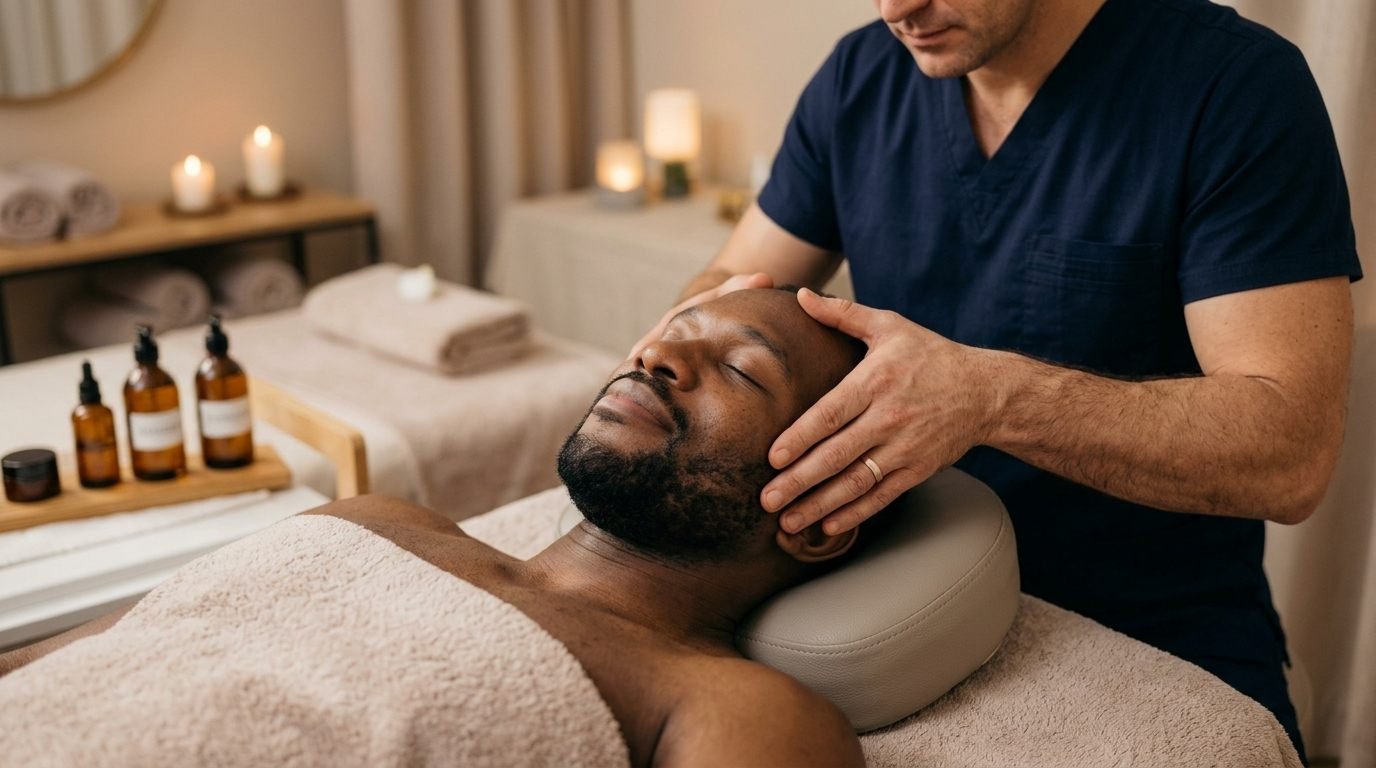
Hands-on work restores circulation to muscles that have been loaded repeatedly without recovery, and gives the whole system a signal to stop bracing. For most people on the tools, an hour covering back, shoulders and legs is the useful option, and our full body Swedish session is built for that.
Plainly: it is not medical treatment and we do not claim it fixes anything. It is recovery and relief. For work that never gets a rest day, that is worth more than it sounds.
When to get it looked at properly
Some things need a GP, not a massage. Speak to your doctor if you have:
- Back pain going down a leg past the knee, with numbness or pins and needles
- Shoulder pain that wakes you at night or stops you lifting your arm to shoulder height
- Weakness or clumsiness in a hand, or dropping things
- Pain that has not shifted at all in several weeks
One specific to the trades: if your fingers go white, numb or tingle after using vibrating tools, especially in the cold, get it checked and tell your employer. That can be hand arm vibration syndrome, it is an occupational health issue with legal reporting duties, and it does not improve by being ignored. A massage is not the answer to it.
See our disclaimer for how we handle this.
Booking around site hours
Site days usually start and finish early, which works in your favour. We are open until 8pm Monday to Friday and 10am to 6pm Saturday, so a session after you knock off is realistic rather than theoretical.
We are at 44 High St in the centre of Slough, handy for the Trading Estate and the sites around town. A 30 minute session is £40 for focused work on the worst area; an hour is £60 if you want the back, shoulders and legs dealt with properly.
If you have never had one, this explains exactly what happens. Otherwise get in touch and we will find you a slot.
Worth knowing through the winter: cold muscles, no warm up and an early start are a harder combination than the same work in summer. We went through why here.
Please note
Work Break is a massage studio. We are not doctors, physiotherapists or mental health professionals, and nothing in this article is medical, psychological or diagnostic advice. What you read here is general information, written from experience of treating people who work hard. It is not clinical guidance and it should not be used to diagnose or treat any condition.
Massage with us is for rest and relaxation. If you are in pain, feeling unwell, or struggling with your mental health, please speak to your GP or another qualified professional. If symptoms are severe, sudden, or getting worse, seek medical advice without delay.
Where we mention research or statistics, they are included for general context only and are not a recommendation of any treatment. You can also read our full Disclaimer and Terms and Conditions.
Search
Topics
Categories
Latest Posts
Recent Posts
Worn down?
30 min £40 · 60 min £60. Open until 8pm weekdays, plus Saturdays and Sundays.
Book Your Work Break
44 High St, Slough. Weekday evenings until 8pm, plus Saturdays and Sunday evenings.